ACFW2026: Civic Space Forum

Event Information
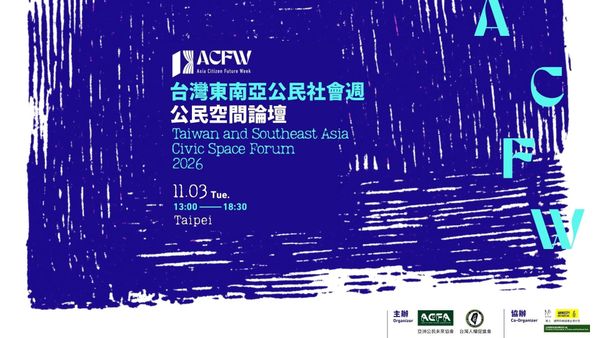
- Date: 2026/11/03 Tue.
- Registration and lunch: 12:00-13:00
- Time: 13:00-18:30
- Organizer: Asia Citizen Future Association (ACFA) and Taiwan Association for Human Rights (TAHR)
- Co-organizer:Amnesty International Taiwan, New Bloom and FATASEA Research Working Group
- Location: Event address will be announced through confirmation email one week before the event
- Lunch boxes will be provided at this event. As the quantity is limited, they will be distributed in the order of on-site registration.
Civil society across the region continues to navigate a complex and evolving environment, one shaped by growing legal and regulatory constraints, shifting public discourse, and new challenges to how organizations and communities can safely connect, organize, and operate.
Despite these constraints, civil society and activists across the region continue to build understanding, foster dialogue, and sustain networks of mutual support, working together to better understand shared challenges and to identify practical, collective ways forward.
In a time of ongoing uncertainty, connection and cooperation matter more than ever.
2026 marks the fourth year of Asia Citizen Future Week (ACFW). As civic space continues to evolve across the region, we keep exploring how to connect, exchange knowledge, and support one another, across borders and across different areas of work.
The ACFW 2026 Civic Space Forum brings together NGOs, activists, human rights lawyers, youths, scholars and independent journalists from across the region in Taiwan to build shared understanding of current civic space dynamics and to develop practical, collaborative approaches among partners from Taiwan, Southeast Asia, and beyond.
Keynote Speech
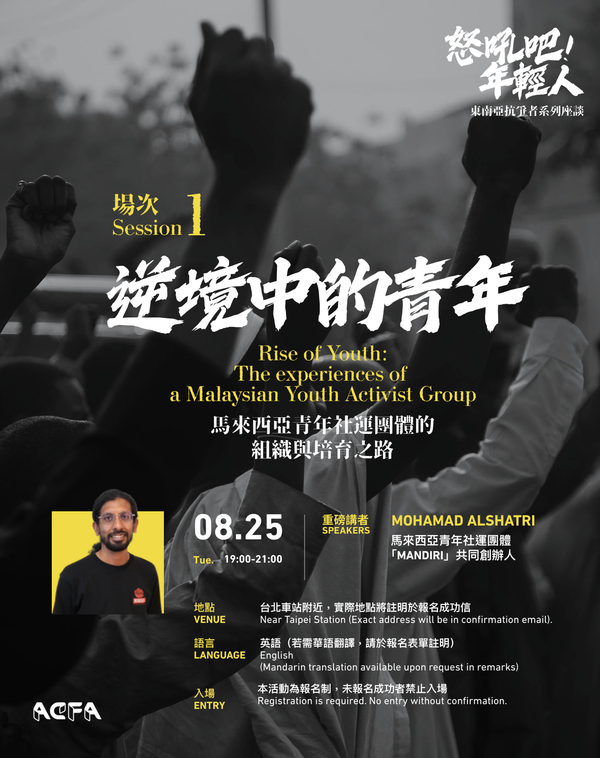
Organizing Anyway: Youth's Rights to Association under Pressure in Malaysia
Malaysia enacted the Universities and University Colleges Act (UUCA) in 1971, which strictly restricts university students from participating in political parties, unions and certain student groups, and allows them to voice their views only through Student Representative Councils managed by the Vice-Chancellor.
For decades, civil society and student movements have called for the Act’s repeal, and over the past year, a new wave of student and youth movements in Malaysia has voiced these demands even more forcefully.
Recently, Prime Minister Anwar Ibrahim announced a suspension of all disciplinary proceedings at public universities relating to freedom of speech, expression, public criticism and peaceful assembly, and stated that the government will fully repeal the UUCA.
This keynote will focus on the legal framework for youth association in Malaysia and the experiences of former youth activists who faced legal harassment for exercising their rights to assembly, association and expression. It will serve as an entry point to the three main themes of today’s forum and to the importance of cross-regional solidarity.
Panel 1
Youths, Actions and the Freedom of Association
In Southeast Asia, youths are often at the forefront of street action and organizing, building cross-border networks to advance social justice and gradually forming vibrant, powerful new cultures and forms of social movement organizing, while at the same time facing various forms of regulation and repression.
In Taiwan, by contrast, youth-led social and street movements have grown quieter, even as young people's energy for founding associations remains strong. Yet the regulatory framework of the Civil Associations Act, combined with a broader social imagination that offers limited space for freedom of association, continues to constrain the development of youth organizing. Moreover, young people from different backgrounds and migration experiences, international students, migrant workers, exchange students, among others, bring highly diverse forms and needs of association that resist being captured by any single framework.
Freedom of association is not only a fundamental human right, but also the foundation upon which social movements take root. This session brings together youth activists from Taiwan and Southeast Asia in dialogue, to explore the motivations, forms, and resources needed for youth organizing, and to further reflect on the significance of freedom of association within contemporary social movements.
Panel 2
Human Rights Defenders Protection: Localized Practices and Cross-Border Coordination
Activists in the region face not only mounting threats to their personal safety but also a persistent lack of adequate and appropriate support. Grassroots and marginalized communities are confronted with an increasingly hostile environment and deepening resource constraints.
As the risks and costs of human rights work continue to rise, how can traditional relief and protection measures, such as temporary relocation, case-based or issue-based public advocacy, and legal or financial assistance, evolve to become more flexible and responsive, so that activists can keep organizing and taking actions, and keep doing so with dignity? This predicament is prompting activists across the region to rethink models of protection, in search of support pathways that are more agile and more attuned to local contexts.
This session brings together practitioners from Taiwan and Southeast Asia to explore, from their respective movement experiences: what conditions enable human rights defenders and civil society in the region to build effective mutual support and protection? And how can we build a regional mutual support network that is more grounded in local contexts, flexible, and organic?
Panel 3
Authoritarianism and Xenophobia: Impacts and Responses
Across the region, we can see a troubling trend taking shape: critical voices and actions are increasingly met with strategic suppression and stigmatization from ruling powers and conservative forces alike. At the same time, public discourse is growing ever more polarized, leaving already-marginalized communities at the frontline, bearing the brunt of the most extreme violence and attacks.
Drawing on the observations and frontline experience of activists from Taiwan and Southeast Asia, this session explores: what concrete impacts has the recent rise of conservative backlash had on civil society and social movements across the region? And how can activists unpack the deeper dynamics driving this headwind, and develop effective responses to it?