Forum Information
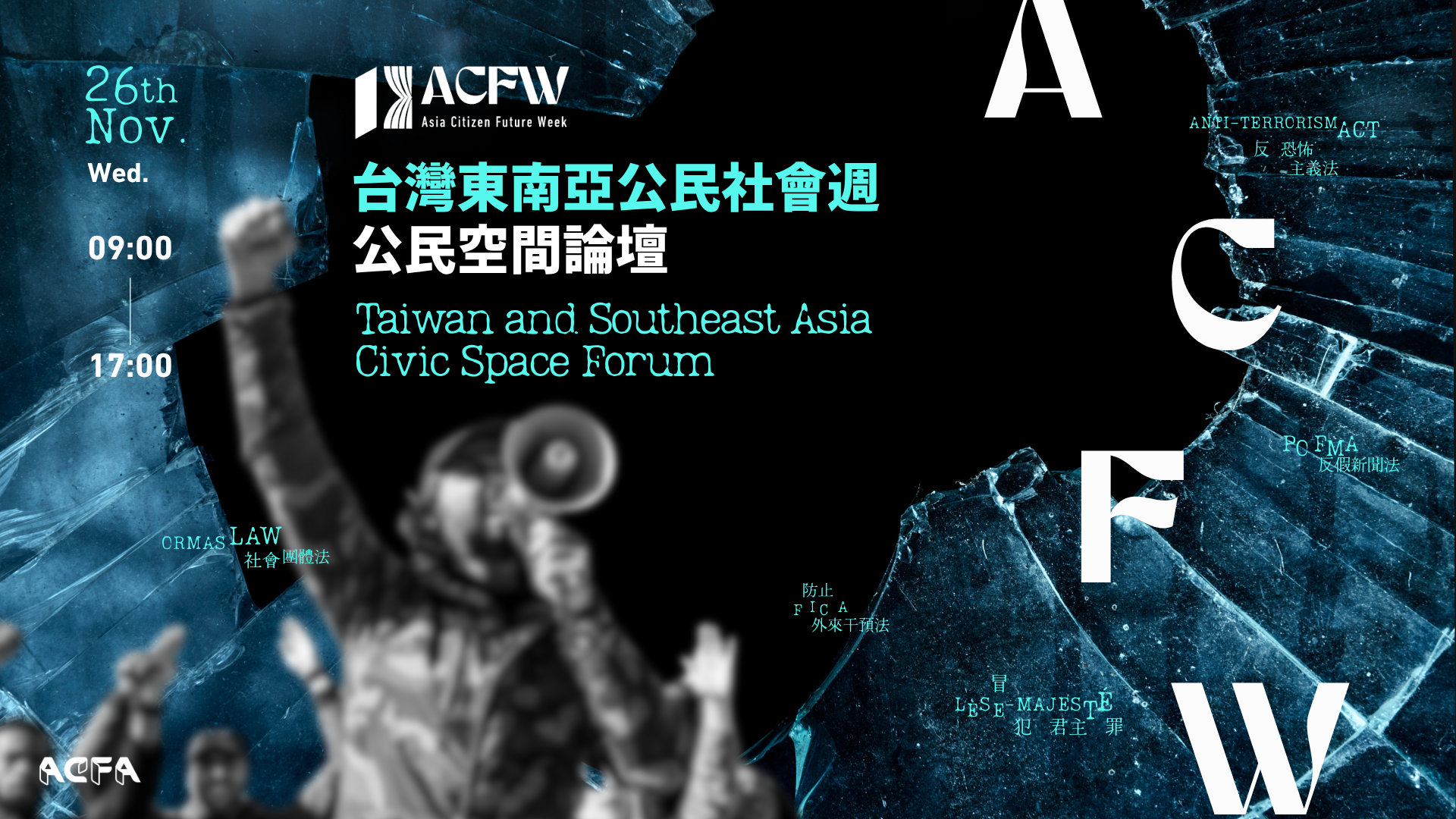
Location: Taipei, Taiwan.
Date: November 26, 2025
Registration: 9:00
Time: 9:30-18:00
Entrance control: Please bring your confirmation letter to the reception desk.
The Asia Citizen Future Week 2025 (ACFW2025) will center on two main themes: advancing regional reforms to safeguard freedom of association, and fostering dialogue and imagination toward the creation of a regional human rights defenders (HRDs) protection mechanism in Asia.
As ACFW’s flagship public event, the ACFW2025: Civic Space Forum will address urgent regional challenges, including ongoing restrictions on freedom of association, the use of judicial institutions to accelerate the resurgence of authoritarianism and militarism, and the growing risks faced by HRDs, while noting the lack of a regional HRD protection mechanism in Asia.
The forum will bring together NGOs, academics, government representatives, and other stakeholders from across the region to deepen understanding of these pressing issues among participants from Taiwan, Southeast Asia, and beyond, and to explore possibilities for strengthened cross-regional cooperation.
Opening Remarks
Leah Lin—Founder and Executive Director, Asia Citizen Future Association (ACFA)
Featured Address 1 (online)
Featured Address: The strength and the experience in movement-building of a young Rohingya genocide survivor
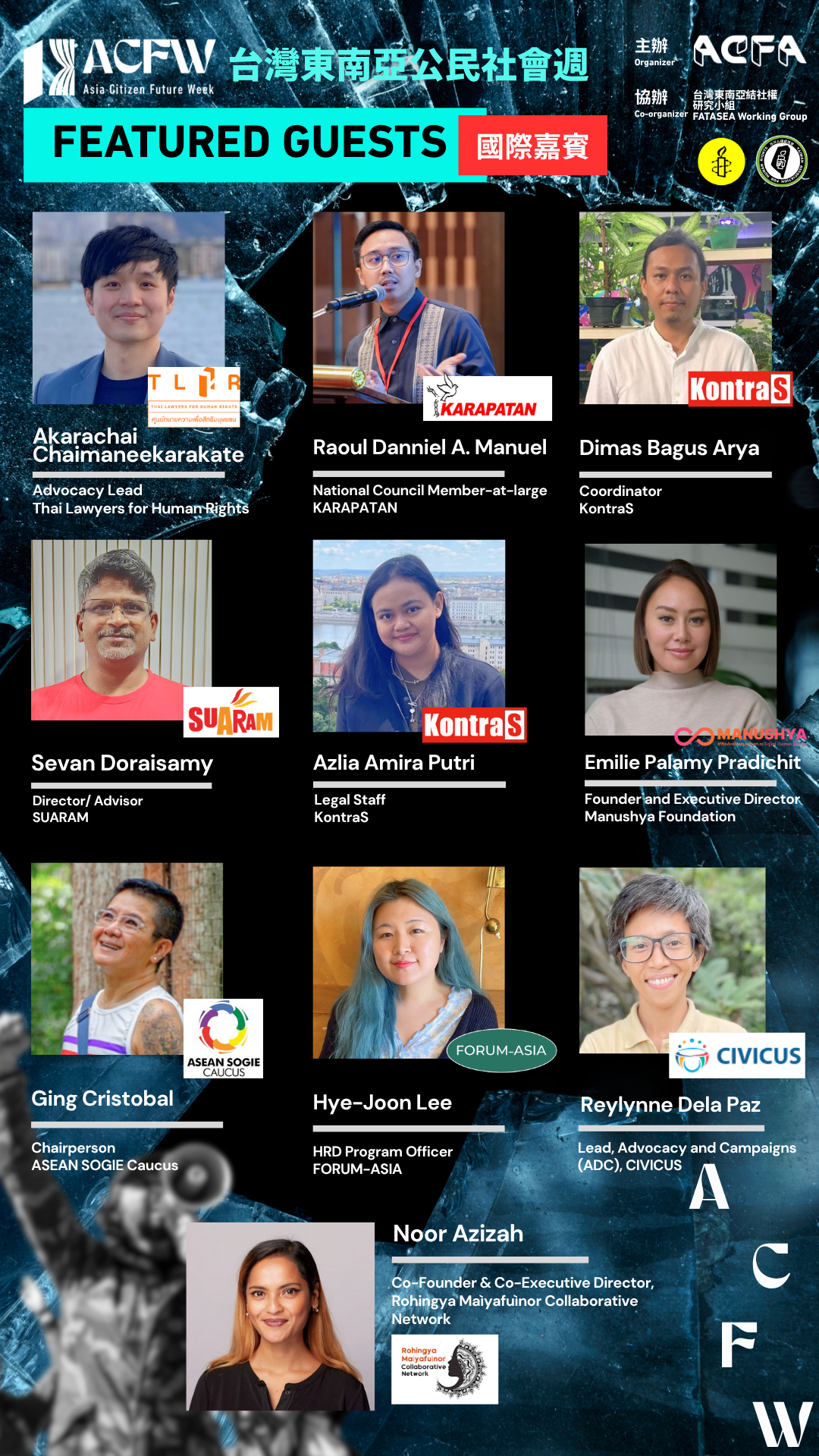
Noor Azizah,Rohingya Maìyafuìnor Collaborative Network
Noor Azizah is the co-founder of the Rohingya Maìyafuìnor Collaborative Network, a refugee-led, Rohingya women-driven organization. She actively advocates for displaced Rohingya communities across ASEAN, particularly those affected by armed conflict, persecution, and forced displacement. Through her work, Noor organizes advocacy initiatives, delivers humanitarian aid, and builds strategic alliances to address the urgent challenges facing her community.
Featured Address 2
From Exile to Building Protection in Asia
Emilie Pradichit, Founder and Executive Director, Manushya Foundation
Emilie Pradichit is a woman human rights defender, decolonial intersectional feminist and an international human rights lawyer. Born into a refugee family from Laos, Emilie founded Manushya Foundation in 2017, working at the intersection of digital rights, climate justice, protection of defenders, transnational repression, and access to justice. Through her foundation, she reinforces the power of women and youth advocacy for democracy, social justice and equality, while also defending indigenous, forest dependent, LGBT+ and marginalized communities across Southeast Asia.
Session 1 : Situation of Freedom of Association in the Region: Challenges Across Various Groups in Taiwan and Southeast Asia
Freedom of association is a fundamental part of civic space. It affects human rights groups, workers, students, grassroots communities, women, LGBT+ groups, migrants, persons with disabilities, indigenous people, and children. Yet across different political systems, the right to freedom of association is neither fully protected nor genuinely accessible. In recent years, organizations across Southeast Asia have faced increasingly restrictive laws and heightened state oversight. In Taiwan, civil society organizations also encounter significant practical barriers due to regulatory frameworks that fall short of international human rights standards and reflect a restrictive regulatory approach.
This session aims to explore the realities of freedom of association and the challenges faced by different communities when this right is constrained. It will not only identify the threats and attacks faced by civil society and grassroots groups in Taiwan and Southeast Asia, but also examine how they have adopted innovative strategies to continue their work under such challenges and repression.
Moderator:
Doris Yang | Project Manager, Asia Citizen Future Association (ACFA)
Speakers:
- Leah Lin | Founder and Executive Director, Asia Citizen Future Association (ACFA)
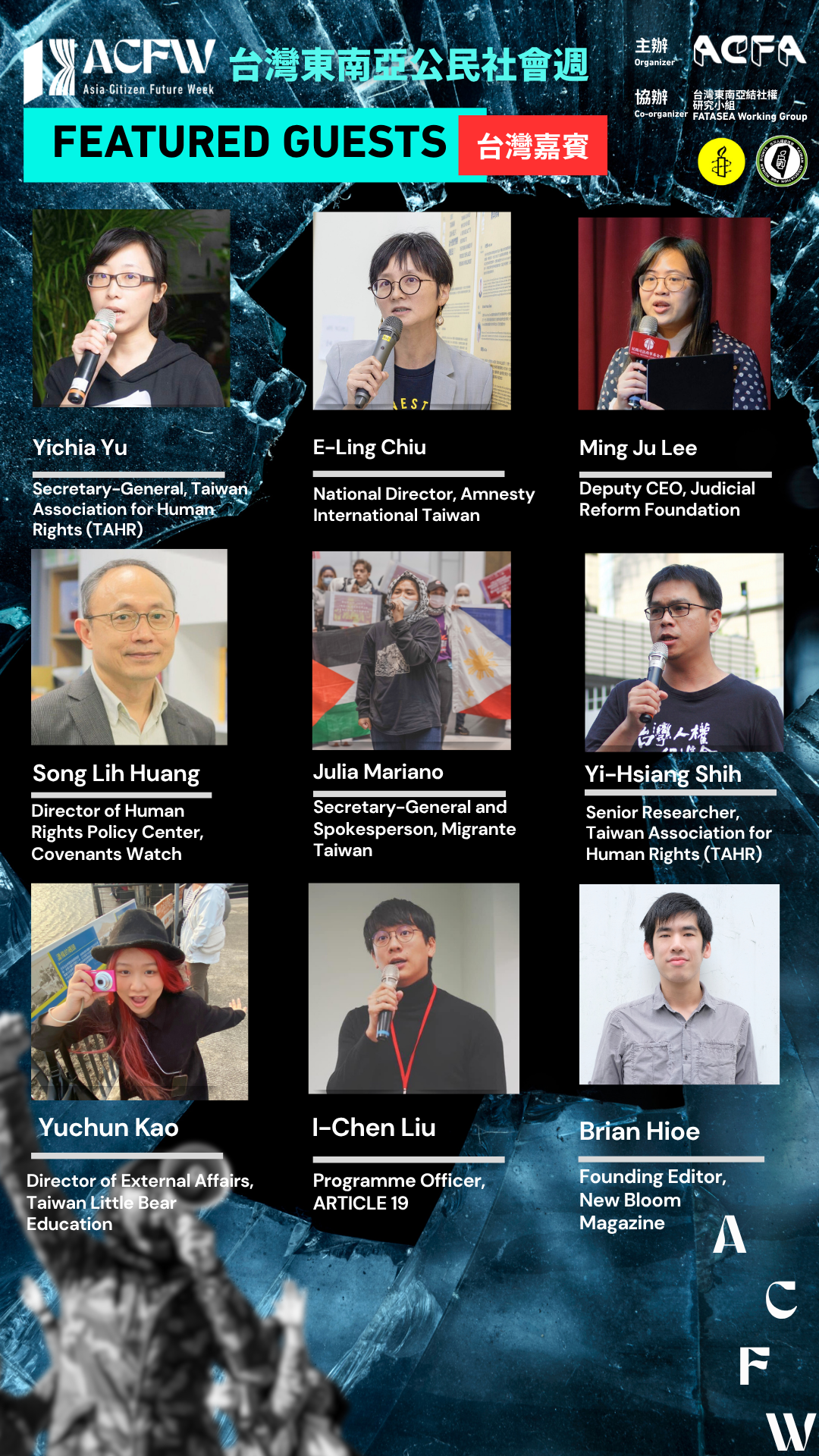
- Yi-Hsiang Shih | Senior Researcher, Taiwan Association for Human Rights (TAHR)
- Azlia Amira Putri | Legal Staff, KontraS
- Ging Cristobal | Chairperson, ASEAN SOGIE Caucus
- Yuchun Kao |Director of External Affairs, Taiwan Little Bear Education
- Julia Mariano | Secretary-General and Spokesperson, Migrante Taiwan
Session 2: How Does the Judiciary Fuel Authoritarianism in Taiwan, Thailand, the Philippines, and Indonesia?
In recent years, judicial institutions and legislation have been weaponized to consolidate authoritarian and militaristic agendas in some of the Southeast Asian countries. For example, in Thailand, the Constitutional Court rulings have been used to dissolve opposition parties; in Indonesia, the Constitutional Court paved the way for Jokowi's son to run for Vice President. In the Philippines, the Supreme Court upheld the Anti-Terrorism Act, which has been widely used to repress dissidents. In Taiwan, the Constitutional Court has been suspended for over 270 days as of late October 2025.
This session examines how legal and judicial systems, including constitutions, constitutional courts, criminal procedure laws, and special restrictive legislation, are strategically weaponized to undermine democratic institutions across Southeast Asia. It will also explore how these tactics affect civil society organizations and human rights defenders, as well as how activists and civil society actors resist such trends and defend judicial independence through advocacy and collective action.
Moderator: Sevan Doraisamy | Advisor/Director, SUARAM
Speakers:
- Akarachai Chaimaneekarakate | Advocacy Lead, Thai Lawyers for Human Rights
- Dimas Bagus Arya | Coordinator, KontraS
- Raoul Manuel | National Council Member-at-Large, KARAPATAN
- Ming Ju Lee | Deputy CEO, Judicial Reform Foundation
Featured Address 3:
People Power Under Threat: The Urgent Need for Defending Civic Space
Speaker: Reylynne Dela Paz| Lead, Advocacy and Campaigns, CIVICUS
Voice of Solidarity
Chuveath “Jay” Dethdittharak—Vocalist and Guitarist, The Commoner Band
Session 3: Envisioning Human Rights Defenders Protection in Asia
With the shrinking civic space and resurging authoritarianism intensifying across Southeast Asia, human rights defenders (HRDs) face urgent and escalating threats. Yet, there remains no regional protection mechanism, leaving emergency support and relocation efforts to local human rights groups, international civil society networks, and regional organizations.
When HRDs in Asia come under threat, they often have no choice but to rely on rapid-response assistance from local organizations, or to appeal to international emergency protection and relocation schemes, many of which have high entry barriers. For example, temporary relocation programs are often geographically distant, costly to access, and require English or other foreign-language skills, effectively excluding grassroots defenders and those from rural or marginalized communities.
This session envisions the creation of an Asia-based HRD protection mechanism, one that is flexible, regionally rooted, and accessible. It will also examine Taiwan’s potential and challenges as a host and support hub for at-risk HRDs in the region.
Moderator: Meg Chen | Project Officer, Asia Citizen Future Association (ACFA)
Speakers:
- Yi-Chia Yu|Secretary-General, Taiwan Association for Human Rights (TAHR)
- Hye-Joon Lee|HRD Program Officer, FORUM-ASIA
- Song-Lih Huang|Director of Human Rights Policy Center, Covenants Watch
- Raoul Manuel|National Council Member-at-Large, KARAPATAN
- Dimas Bagus Arya|Coordinator, KontraS
- Emilie Palamy Pradichit|Founder and Executive Director, Manushya Foundation
Session 4: Geopolitical Tensions and Civic Space: Can Taiwan Be a Shelter for Human Rights Defenders?
Over the past decade, with its relatively open civic space and the democratic value it upholds, Taiwan has emerged as an important site for CSOs across Asia to build cross-border solidarity and continue their work despite repressive government crackdowns.
This session aims to explore Taiwan’s strengths and opportunities that allow it to remain a safe haven for CSOs and HRDs facing threats across the region. It also seeks to identify the principles that can be learned or should be applied amid the current social and political climate.
Moderator: Leah Lin | Founder and Executive Director, Asia Citizen Future Association (ACFA)
Speakers:
- E-Ling Chiu | National Director, Amnesty International Taiwan
- I-Chen Liu | Programme Officer, ARTICLE 19
- Brian Hioe | Founding Editor, New Bloom Magazine
- Speaker 4
Closing Remarks
Yi-Chia Yu—Secretary-General, Taiwan Association for Human Rights (TAHR)